End-to-End Analytics Project
Profit, Demand and Customer Insights — a four-year business intelligence investigation into why a coffee shop with strong sales was barely breaking even, and exactly what to do about it..
The Problem
A specialty coffee shop had four years of transaction data and no clear picture of what was actually working. Sales were growing. Customers were returning. But the profit margin told a different story — at just 2.9% on $45,134 in total sales, the business was generating revenue without generating meaningful financial return.
Management had no analytical framework to understand why, or where to look first. This project was built to change that — from the ground up.
Working end-to-end across the full analytical pipeline — raw data, cleaning, modelling, dashboards, and recommendations — the analysis surfaced a structural pricing problem hiding inside what looked like a success story.
Key Findings
The Sales Paradox
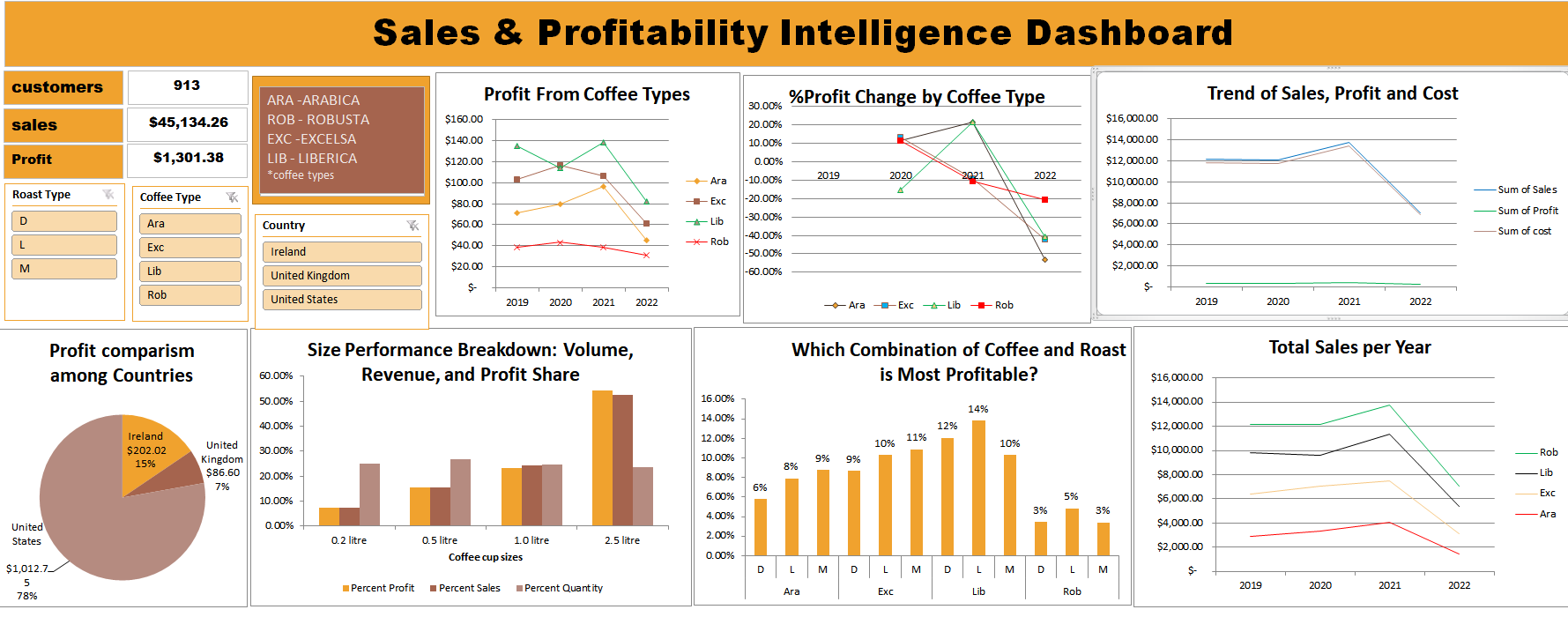
Robusta was the best seller and the worst profit generator. It consistently led every year in sales volume but returned the lowest profit across all three roast types. The business was working its hardest for its least financially rewarding product.
The Hidden Champion
Liberica Light Roast delivered the highest profit margin in the entire range — yet was never prominently marketed. It was sitting in the data quietly outperforming everything else on a per-unit basis, invisible without analysis.
The Size Opportunity
All four cup sizes attract roughly equal order volumes. Yet the 2.5litre size contributes 30% of total profit. It is not underperforming — it is underexposed. The opportunity is steering existing demand, not creating new demand.
Geographic Concentration
The United States accounts for 78% of total profit. The UK contributes only 7% — suggesting either low market penetration or poor product-market fit that warrants a focused review before further investment.
Loyalty Programme Gap
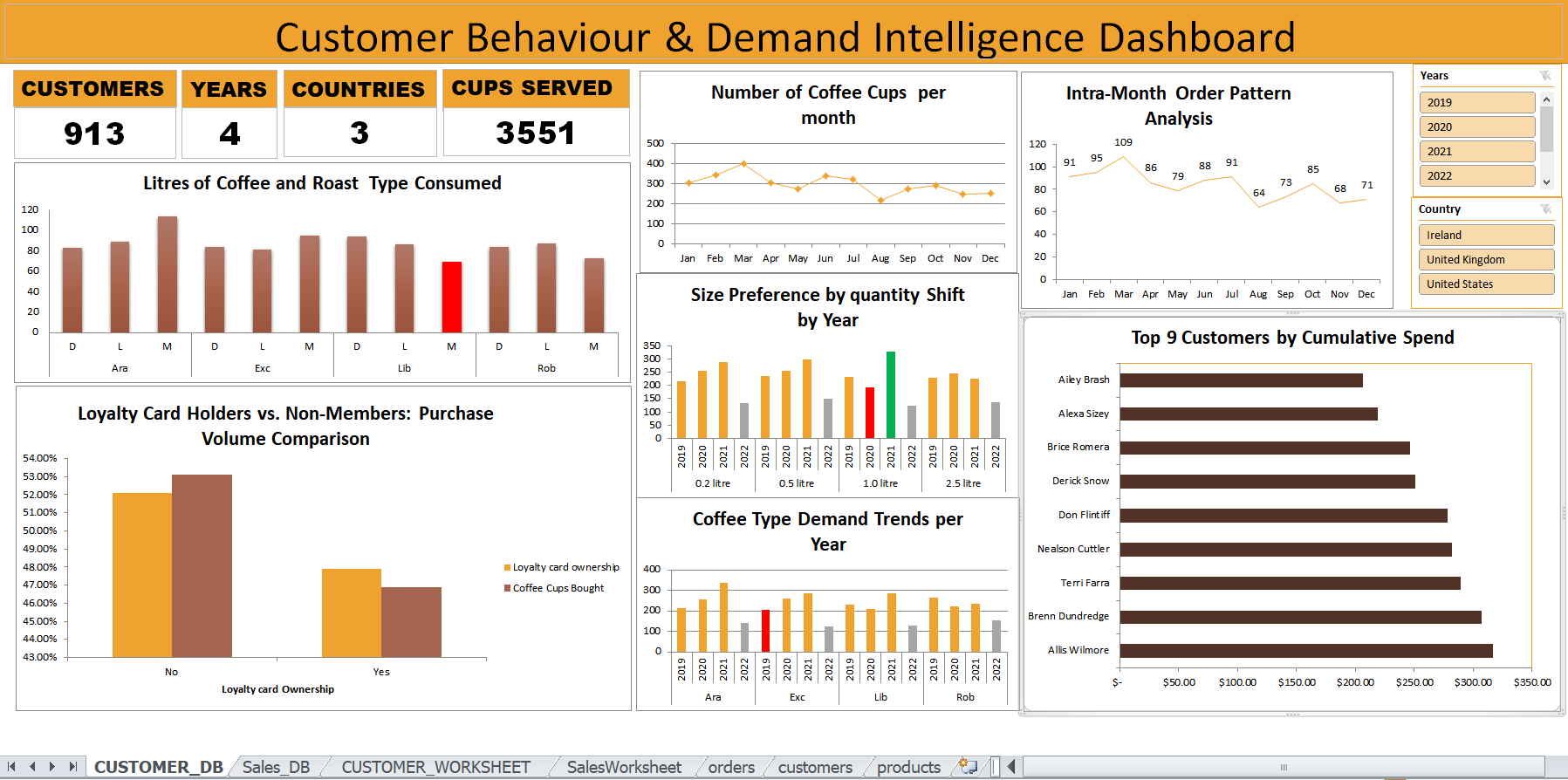
Non-loyalty card holders slightly outpurchase cardholders — inverting the fundamental logic of the programme. The system designed to increase purchase frequency is not delivering on its core purpose.
Predictable Seasonality
Order volumes peak consistently in February–March (400+ cups) and fall significantly in August–October (~200 cups). This four-year-consistent pattern gives operations a reliable planning window that had never been formally identified.
The Dashboards
Sales & Profitability Intelligence Dashboard
Built to answer the business's most pressing commercial questions — which products are making money, which markets are worth investing in, and whether revenue growth is actually translating into profit.
Dashboard Preview
Dashboard Preview
Customer Behaviour & Demand Intelligence Dashboard
Built to answer the human side of the business — who the customers are, what patterns drive their behaviour, and when and how demand moves across the year.
"The business does not need more sales.
It needs better sales."
913 customers · 3,551 orders · 4 years of consistent demand · The market was there. The pricing strategy was not keeping up with it.
Recommendations
The product that powers the most sales is silently eroding profitability. A pricing review or cost structure investigation is the single highest-priority action the business can take. Robusta's dominance in volume makes this problem invisible on the surface — and catastrophic if left unaddressed.
Feature it prominently on the menu, train staff to recommend it, and position it as a premium option. Redirecting even 15% of existing customer demand toward the highest-margin product would have a measurable impact on profit without requiring a single new customer to walk through the door.
Tie loyalty points specifically to 2.5litre purchases and Liberica orders. This fixes two problems simultaneously — activating an underperforming programme and steering customer behaviour toward higher-margin products. A programme that rewards margin-positive behaviour serves the business as much as the customer.
Display it prominently as the "Best Value" option. Offer a top-up deal — "Upgrade from 1 litre to 2.5 litre for just $X more." The 2.5litre generates 30% of total profit on equal order volume to other sizes. It is not underperforming. It is invisible to the customers who would choose it if prompted.
Project Details
Tools Used
Microsoft Excel · Power Query
Techniques
Data cleaning · Pivot tables · % difference analysis · Dashboard design · Data modelling
Period Covered
January 2019 – August 2022
Dataset Size
3,551 orders · 913 customers · 3 countries
Dashboards Built
2 interactive Excel dashboards · 11 visuals total
Key Limitation
2022 data terminates in August — year-end figures are not fully representative
Analyst
Oluwatosin Olajumoke Ogunwale
Project Type
Independent portfolio project — end-to-end
Deliverables
2 dashboards · Written report · README · CV project entry · Cover letter
The complete project — raw data, cleaned dataset, dashboard files, full written report, and documented methodology — is available on GitHub.